
Apr 16, 2026
Upcoming Webinars

Brazil’s Tax Reform: Building a Resilient SAP-Centered Tax Compliance ArchitectureBrazil’s tax reform has begun and is not only redefining compliance—it’s reshaping how companies operate at scale. As new mandates, electronic documents, and tax models are introduced, organizations are rethinking the role of technology in managing tax determination, transaction reporting, and operational resilience. In this session, Sovos and SAPinsider explore how leading companies operating in […]

From Spreadsheet Chaos to AI-Ready Product DataProduct data sits at the core of every exceptional customer experience. Yet within many SAP-run enterprises, product information is still managed through spreadsheets, manual enrichment steps, and disconnected team workflows. Across industries, teams spend countless hours updating Excel files, tracking down missing attributes, and fixing human errors. What starts as a simple workaround often becomes […]
Apr 28, 2026

Zero Trust for SAP: End-to-End Security & Visibility for Users and Workloads in Every CloudAs enterprises transition their SAP investments to the cloud, securing users and workloads is mission-critical. Whether migrating SAP systems to SAP Private Cloud Edition (PCE) under the RISE program or managing them directly on hyperscalers like AWS, organizations require advanced security and real-time visibility to ensure seamless operations. Join Zscaler, the trusted security partner for […]
Apr 29, 2026
Past/On-Demand Webinars

Keeping SAP Cloud ERP in your Data Center: Reducing Risk Without Sacrificing InnovationAs organizations evaluate SAP Cloud ERP, many assume they must move everything to a hyperscaler to access innovation and a true cloud operating model. In reality, SAP Cloud ERP Private can run in your own data center or co-location facility while delivering the same software capabilities, lifecycle management, and AI innovations as hyperscaler deployments. In this on‑demand webinar, SAP’s Rakesh Rushan and HPE’s Jim Loiacono join SAPinsider’s Robert Holland to explain the SAP Cloud ERP Private, Customer Data Center (CDC) option—including how it works, where it fits, and why many customers see it as “cloud on‑site” rather than legacy on‑prem.
You’ll hear how leading organizations are bringing a full cloud experience—including embedded and generative AI—into their own environments, keeping ERP close to critical non‑SAP systems while SAP manages the full stack as a subscription service. The speakers walk through practical considerations such as data residency and sovereignty, total cost of ownership versus hyperscaler options, time‑to‑value, and support experience, so you can decide whether running SAP Cloud ERP in your existing data center aligns with your long‑term architecture and risk strategy.
Why watch this webinar on demand:
- Understand how the SAP Cloud ERP Private, Customer Data Center option works and how it compares to hyperscaler-based deployments in terms of capabilities, operations, and SLAs.
- See how “cloud on‑site” lets you keep SAP Cloud ERP physically in your own or a co-location data center while SAP delivers a fully managed cloud service with up to 99.9% application‑level availability.
- Learn how CDC helps you meet stringent data residency, privacy, and sovereignty requirements by keeping ERP data in your chosen location while still consuming SAP’s continuous innovation and Business AI.
- Explore how co‑locating SAP and non‑SAP systems can reduce integration complexity, latency, and data egress costs, especially for analytics and large‑scale AI workloads.
- Get practical guidance on when CDC is a better fit than hyperscalers—based on data dependencies, risk and compliance, time to value, and your existing data center and infrastructure investments.
Mar 26, 2026

From SAP BPC to AI-driven Finance—Without Starting OverIn this on-demand session, experts from Column5 and Wolters Kluwer’s CCH Tagetik team share a practical roadmap for modernizing and unifying planning and consolidation, while still preserving what your teams value most about your SAP ecosystem. You’ll hear how BPC customers are moving to CCH Tagetik (including on SAP HANA) to handle larger, more granular data sets, improve performance, and create the foundation needed to truly leverage AI.
You'll gain clarity on:
- The pros and cons of today’s top paths—staying on BPC, moving to a new platform, or adopting a hybrid approach—and which best align with enterprise-scale complexity and SAP-centric roadmaps.
- How to unify FP&A and financial consolidation in a single platform, including scenarios where CCH Tagetik provides native integration to S/4HANA, ECC, BW, and non-SAP ERPs—without disrupting finance or overburdening IT.
- The AI capabilities that actually matter for modern finance teams, from predictive forecasting to process automation, and why a robust, granular data foundation is essential to realizing ROI.
- A risk-mitigated transition framework, built on 20+ years of BPC experience at Column5, to preserve what works (master data, reporting, and familiar Excel experiences) while modernizing processes, ensuring continuity, stakeholder confidence, and audit integrity.
If you’re a CFO, Controller, Head of FP&A, or Financial Systems leader, this webinar on demand will help you decide whether to continue with BPC in the near term, adopt a hybrid path, or chart a full migration to an AI-ready EPM platform—because modernizing your finance platform shouldn’t mean having to start over
Mar 25, 2026

Superior Data Control & Sovereignty with SAP Cloud ERP/RISE On-site SolutionsGeopolitical and data custody risks can be eliminated by bringing SAP Cloud ERP innovation to your SAP data in your current datacenters or choice of local colocation datacenters. SAP has expanded SAP Cloud ERP Private (aka RISE) hosting options to include on-site hosting options.
SAP Cloud ERP Private, Customer Data Center hosting option decouples your mission-critical operations from external unpredictability, ensuring your data remains exclusively under your custody and away from false sovereignty claims which are often subject to foreign legal jurisdiction.
In this on-demand webinar, hear directly from a Cloud ERP Private RISE customer, Infrastructures de Portugal, how this on-site cloud option avoids risk, eliminates the additional costs of hyperscale cloud datacenter migrations, and provides more cloud value than hyperscale cloud hosting for hybrid/multi cloud customers.
Watch On Demand to:
- Learn why SAP Cloud ERP/RISE is pivoting from US Hyperscale Cloud to On-site solutions for sovereignty & control
- Understand how Cloud ERP/RISE on-site options eliminate US hyperscaler jurisdictional risk
- Clarify data residency vs. sovereignty and custody vs. management services
Mar 24, 2026
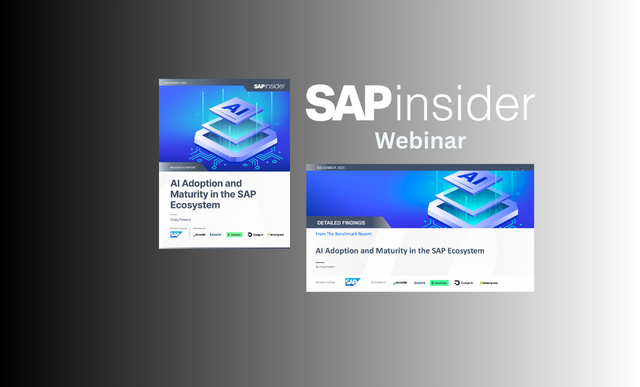
SAPinsider Research Webinar: AI Adoption and Maturity in the SAP EcosystemAI adoption in the SAP ecosystem is broad but still mostly at early- to mid-stage maturity, with most organizations experimenting or operating at a foundational level rather than running fully scaled, transformational programs. While 91% report some AI use and many have basic governance, only a minority have deeply embedded AI across end-to-end workflows or […]
Mar 19, 2026

Beyond the “vTax”: Future-Proofing Your SAP InfrastructureThe shifting landscape of virtualization licensing has introduced a new "vTax," leaving SAP customers grappling with escalating infrastructure costs and unpredictable renewal cycles. To protect your SAP ROI, it is time to look beyond legacy proprietary hypervisors.
Watch this session to discover a strategic path to cost-efficiency and performance by migrating mission-critical SAP workloads—including SAP HANA—to SUSE’s KVM-based virtualization. We will analyze the financial impact of Broadcom’s new licensing models and provide a technical deep-dive into how an open-source, SAP-certified hypervisor can deliver the enterprise-grade high availability and performance your landscape demands.
Learn how to reclaim your budget without compromising the stability of your SAP environment.
Watch now to learn:
- How to protect SAP ROI from escalating "vTax," and unpredictable licensing costs
- How an open-source hypervisor like SUSE KVM provide the same enterprise-grade reliability and performance required for SAP HANA
- How to reclaim your budget and eliminate licensing friction without compromising the stability of our mission-critical SAP environment
- The way to modernize our infrastructure and reduce operational silos by aligning our hypervisor with our existing OS
Mar 11, 2026

Securing SAP S/4HANA in a Hybrid Environment with Zero TrustSAP S/4HANA is built for connectivity—integrating with business partners, on‑prem infrastructure like print servers, cloud workloads, and SaaS applications. While this hybrid model enables real-time insights, advanced analytics, and AI-driven innovation, it also expands the attack surface. Traditional perimeter-based security built on firewalls and VPNs wasn’t designed for today’s distributed SAP landscape—and falls short on visibility, segmentation, and least-privileged access.
Zscaler’s cloud-delivered Zero Trust architecture helps secure SAP S/4HANA across hybrid environments by enforcing identity- and context-based access and simplifying workload security. Join this webinar to learn how to gain visibility into workload traffic, reduce exposure, and contain threats faster—without the complexity and operational overhead of legacy approaches.
Watch now to learn:
- Why firewalls and VPNs fall short for hybrid SAP—and why a proxy-based Zero Trust model is better suited
- How to grant secure access to business partners without exposing S/4HANA or your network
- How to secure S/4HANA communications with print services (print servers/printers) in on‑prem environments
- How to protect traffic between S/4HANA and SaaS apps with consistent policy enforcement and inspection
Mar 5, 2026

DIY or Done-for-You? Rethinking Tax Compliance Strategy in SAPHow Tax Compliance Is Changing in SAP
Tax compliance in SAP is no longer just an IT decision. It’s a strategic risk decision.
As governments shift to real-time, transaction-level enforcement, SAP customers are being forced to rethink how tax compliance fits into their S/4HANA, Clean Core, and data governance strategies.
Many organizations are evaluating ERP-native approaches, while others are expanding their capabilities to account for authority-led, end-to-end compliance models designed to keep pace with continuous mandates. Each path comes with tradeoffs in cost, risk, scalability, and long-term agility.
In this session, Sovos tax and SAP experts explore how SAP customers should think about this decision, not from a product perspective, but from an enterprise architecture, risk, and operating model standpoint.
You’ll learn:
- Why tax compliance is shifting from an internal ERP function to an externally enforced, authority-led model
- What SAP customers should consider when using ERP-native tools for digital reporting and mandates, and what capabilities to enhance and complement those tools
- The hidden complexity behind e-invoicing, SAF-T, and continuous transaction controls
- How Clean Core principles intersect with tax data, controls, and audit exposure
- Key questions IT, Finance, and Tax leaders should be asking before choosing a compliance path
- How today’s compliance decisions can impact transformation risk for years to come
This session is designed for IT and ERP leaders, Finance and Tax executives, SAP CoE and Clean Core program owners, and enterprise architects responsible for compliance strategy, and is especially relevant for organizations preparing for the 2026–2027 regulatory expansion or actively navigating an S/4HANA
Feb 25, 2026

Next-Generation SAP Payments: Mastering Advanced Payment ManagementCorporate payment operations face unprecedented complexity: multiple legal entities, diverse bank relationships, varied currencies, regional regulatory constraints, and multiple payment formats. SAP’s Advanced Payment Management (APM) provides a centralized payment factory that addresses these challenges head-on and supports payments across single or heterogeneous SAP environments.
Join Serrala Treasury Services (STS), pioneers in SAP in-house banking and payment factories, for an expert-led session. Explore the three core payment scenarios enabled by APM: Payments In Name Of (PINO), Payments On Behalf Of (POBO), and Internal/Intercompany Payments, along with how APM-IHB and Multi-Bank Connectivity (MBC) extend the solution for complex, multi-bank landscapes.
You will see practical PINO and POBO use cases, including pass-through forwarding and conversion and forwarding using APM’s XML framework, as well as automated Internal/Intercompany Payments that avoid external bank fees and delays. The session also highlights how APM-IHB optimizes routing and cross-border management and how MBC simplifies bank integration with a single cloud-based connector, embedded SWIFT connectivity, and real-time status updates integrated with BCM
Watch this webinar to:
- Understand how APM centralizes complex corporate payment operations in SAP S/4HANA.
- Learn when to use PINO, POBO, and Internal/Intercompany Payments.
- See how APM-IHB supports POBO, routing optimization, and cross-border management.
- Discover how MBC simplifies bank integration and real-time payment tracking.
- Review key APM technical components that support standardized, high-integrity payment processes.
Feb 19, 2026
Securing SAP Workloads in the Cloud: Moving Beyond FirewallsSAP will end mainstream support for ECC on December 31, 2027, driving organizations to migrate to cloud-based S/4HANA through RISE with SAP. Moving SAP workloads to the cloud unlocks agility and innovation—but it also introduces new attack vectors. For self-managed cloud migrations (AWS, Azure, GCP), customers are responsible for the workload security. Legacy security architectures built on firewalls and VPNs were not designed for the cloud and add unnecessary complexity.
Watch this SAPinsider webinar to learn how deploying a Zero Trust Architecture simplifies and strengthens SAP security, no matter where your workloads run. Discover how to protect data, prevent advanced threats, and securely connect SAP systems across VPCs, VNets, and hybrid environments—ensuring business continuity in a fast-changing IT landscape.
Watch now to learn:
- The limitations of traditional firewalls and why a proxy-based Zero Trust model is essential for SAP.
- Strategies for advanced threat prevention and data protection.
- How to secure SAP connectivity across clouds and hybrid infrastructures.
- Actionable steps to protect workloads and streamline cloud security.
Feb 18, 2026

Protecting SAP ERP Availability & Data Privacy—Be a Hero vs VictimModern cloud ERP exposes new challenges to both SAP ERP availability and privacy. Before October 2025, more than 2,000 organizations believed they were protected by multi-regional cloud architecture, only to be impacted by a single hyperscaler DNS outage that disrupted access across multiple countries for more than 14 hours. That same year, geo-political sanctions abruptly interrupted hyperscaler services for several organizations, and a Microsoft executive confirmed to the French Senate that data cannot be fully protected from U.S. access under the U.S. Cloud Act. In response, the EU Commission released its Cloud Sovereignty Framework version 1.2.1 to assess sovereignty effectiveness, including data and A.I. sovereignty along with countries from every global continent, who also have released their own data and A.I. policies.
This webinar will examine these 2025 incidents and explain how to strengthen SAP ERP availability and privacy through SAP Cloud ERP, Customer Data Center, SAP Sovereign On-site, and S/4HANA On-site deployments. Attendees will learn strategies for guarding against global DNS or IAM outages, meeting privacy obligations under the EU Digital Operational Resiliency Act, and navigating global AI regulations.
Watch Now to:
- Review the major SAP ERP cloud outages and privacy risks of 2025.
- Understand options that eliminate hyperscaler fiduciary risk.
- Clarify data residency vs. sovereignty and custody vs. management services.
Feb 17, 2026